Monday, August 17, 2009

Very Nice, This Belgium


What is Belgium? What is its character, its flavor, aside from European bureaucracy and dikes? Dikes, right, or is that Holland? What I know of the place from the screen is fairly dour- Jeanne Dielmann's frightful frigidness, The Man Who Cut His Hair Short's ugly psychic landscape. Toute une nuit may have spiced up the mix, but the backdrop remained uninspiring. And now we have the Dardennes to seal the deal for provincial Americans who live by the screen- Belgium is nothing but an industrial plant peopled by Europe's morally challenged marginals, strange folk some of who may speak French, but do very unsophisticated things to their kin and themselves.

It just so happens that my two most recent theatrical viewings were crafted by Belgians, but one by a filmmaker no longer associated with that flat nation. The truly Belgian film, the Dardennes' newest Lorna's Silence, strikes at the heart of the European soul, while Agnes Varda's Beaches of Agnes lolls on its beaches and avenues.

Lorna's Silence trolls familiar ground for the Dardenne brothers, but I believe dramatizes the conflict between humanist ethics and capitalism's profit motive more powerfully than their previous works (granted, as several reviewers have pointed out, the narrative is more contrived and plotted.) Lorna stands at the crux of the contemporary European soul, half way between the promise of egalitarian liberty and slavery to an underworld increasingly integrated with the official economy. Although this Albanian immigrant in Belgium sees glimpses of the utopian, unified continent- in her ability to emigrate, possibly open a small business, seek protection from a welfare state (as when she is granted a speedy divorce)- she is not a true citizen of anything called Europe. Rather, she is a reified commodity- a source of profit for human traffickers and a name on paper that will hopefully be lost in bureaucratic shuffle. Centuries after the Enlightenment revolutions, the soul of Europe remains locked in struggle between the championed ideal of the free individual and the body reduced to commodity. Lorna's Silence, then, works most powerfully as a critique of reification, of the betrayal of the revolutionary-liberal tradition by capitalism's insidious commodification of citizenship and citizen alike.

The Dardenne brothers' realist style is matched by their insistence on ethical decision as more than plot device, an approach alien to Hollywood. Lorna's decision comes mid-film. Claudy is her husband of convenience, a shiftless junkie, who is marked by Lorna's trafficker to be disposed of by way of a lethal overdose. Despite their emotionless business-like sharing of an apartment, Lorna tries to stall for time until a divorce can go through, thereby saving his life. Her attempt to save Claudy while preserving her self-interested immigration scheme animates this section of the narrative. One night, she comes home to find a dealer in their apartment, with Claudy, who has kicked the habit, fiending for a hit. Brazenly, Lorna locks the dealer out, throws the key out of the window, and, shockingly, strips silently and offers herself to Claudy. Her insertion of bodily affection into this chain of casual cruelty and exploitation is a supreme ethical gesture, daring but curious. Why is it sex, that most crassly demeaned human experience, that which disrupts the functioning of the capitalist imperative? It's preeminent place is a sly surprise in Lorna's Silence, one that injects an air of the mystic and mythic into the film's resolutely quotidian comings and goings.

The trauma of Claudy's eventual murder is internalized by the still silent Lorna in a phantom fetus she imagines to be the result of their tryst. Despite her attempts to move forward with her role in the trafficking scheme and small dreams of entrepreneurship, Lorna has irreversibly tripped up the chain of exploitation. Although her gesture of solidarity with Claudy, that of recognizing him as a human worthy by that dent of life and not a disposable junkie, has ultimately failed, the pains from her womb undermine the plan to marry a Russian thug. As all her plans unravel, she is abandoned by all and prepared for either her deportation or death. Lorna flees her captors, but it is an uncertain
escape; the film closes on her in an abadoned cabin, swearing to her unborn child to protect them both. Allusions to other mysterious, virtuous pregnancies are unavoidable. After all, in a similar situation, shunned and desperate, Mary gave birth to Jesus in rough shelter. Lorna, ironically, has become like a virgin after copulation with Claudy, purified of the tainted money relations of the underworld. Perhaps she falls somewhere between the virtuous virgin of The Marquise of O. and the decidedly unvirtuous Queen Mary, killed by a phantom pregnancy tumor.

In another interesting inversion, the film's ethical impulse comes from Lorna, an Eastern European character, amidst Western Europeans corrupted by the scrappy pursuit of money. This challenges the long-standing geographical narrative of the Eastern and slavic nations of the continent only slowly emerging from a natural proclivity to servility and corruption, be it to feudal lords, Turks, or Communist dictators, and lagging behind the progressive prosperity of the West. The "spirit of capitalism" is capable of awfully vile things, Protestant or not.

Agnes Varda, although associated with France in every way, was actually born Belgian, as her autobiographical essay film, The Beaches of Agnes, tells. True to its title, the lively octogenarian Varda narrates a collage of her life and loves, which all lead back to the sea, suggested as the font of her imagination. The film works both as a personalized account in documentary fashion of her life and work, and as a sly, engaging exploration of creative existence broadly considered, in the manner of her life long friend Chris Marker (who appears in the form of a cartoon cat, why not?) Varda's considerable charm and intuition for successful cinematic experiments (she is clearly having a blast with the camera and montage after all these years!) raise it above narcissistic nostalgia to a true work of art, if a humble one. It is a work that will not be considered an after thought to her career, destined to DVD extra menus, but an essential part of her ouevre.

*********************
I noted in slight alarm today, that aside from these Belgian gems, my viewing and re-viewing list from the past week reads like an Amazon list of sociopathic murderer films: The Bridesmaid (Chabrol, 2004), The Honeymoon Killers (Kastle, 1969), Badlands (Malick, 1973), & Blue Velvet (Lynch, 1986). I'm not sure whether to chalk it up to the DVD collection at my new local library branch, of some darker element of my subconscious rearing up. Oh yes, I can't forget the outdoor screening of Chaplin's The Kid last week- a beautiful saving grace.

Wednesday, August 12, 2009

Down and Out in Late Capitalist America

In case you didn't get the memo, the American dream is dead. It never really was, but what I think most approximates what people have in mind when they bandy about the phrase is the relative prosperity of the post-WWII decades. For the left looking back, it is a paradoxical time of an apparently ascendant working class gaining on the back of continued racism, imperialism, and cultural conformity. Stable employment at decent wages and a pension, affordable and relatively private housing (the white picket fence; Levittown), access to public higher education, law and order, increased standards of living for your children, a rich community and cultural milieu, a car in the driveway and chicken in the pot- this is the stuff of the American dream. What enabled parts or all of the dream for large segments of America was capitalism's state-sanctioned compromise with labor, backed by emerging American superpower status. Part Keynesian New Deal remnants, part militant labor demand (CIO, etc.) remnants, this compromise allowed for increasing real wages in exchange for peace and productivity in the workplace. The post-war global hegemony of the US ensured that this transformation to an affluent consumer society could take place on the backs of exploited nations and peoples. The ideology of American exceptionism and meritocracy seemed to be coming into focus with material reality for the white middle class and organized working classes.

Its a crude schema, for sure, but I present it because I do think there is something to "the American dream" beyond its ideological utility. There's a whiff of egalitarian possibility to it that can be deployed by both left (the Communist Party's "working class Americanism", the contemporary labor movement's rhetorical emphasis on middle class lifestyles) and right (the fable of a return to innocence via conservative morality). Needless to say, the material conditions for the dream have long since been destroyed in the neo-liberal turn (off-shoring American industry, destruction of organized labor, defunding social services, privatization.) This is another story, the very narrative we find ourselves in now, where the fumes of the dream evaporate into the sober tragedy of foreclosed subdivisions, historic unemployment, and the financial voodoo of Wall Street. Modern capitalism of steel and stuff is long gone in the U S of A. Now we stumble through a late capitalism of spectacle and speculation, awaiting the next crisis.

No one told Hollywood. New American Cinema's brief 70s afterglow made some room for bold explorations of the dream gone bust- Barbara Loden's recently rechampioned Wanda is my immediate association- only to fade into the banality of the 80s and 90s. This is not to say that socioeconomic reality is ignored by Hollywood, which has to make its requisite prestige pics and occasionally grasp for a sympathetic, verite gloss of the poor and downtrodden. Overwhelmingly, however, American society is schizophrenically portrayed either as a smooth, prosperous backdrop for various romantic foibles and heroics, or as a spectacularly dysfunctional country on the razor's edge of dystopia. Neither approach critically explores society. American cinema by and large has no incentive do so when the audience growth markets appear to be torture pics and postmodern quirk.

And so imagine my shock to have earlier this year viewed two contemporary American films in a single week that both attempt a critical, challenging portrait of late capitalist America. Its protagonists change their clothing in gas station bathrooms, and it is not sexy; submit themselves to humiliating acts of violence, and it is not funny. Indeed, the extreme sobriety of The Wrestler and Wendy and Lucy indicate what a grim task dissecting the decomposing corpse of the American dream must be for a serious filmmaker.

I'll examine the 2 films through their protagonists, using the scheme Wendy->adult experience in late capitalist America->Randy "The Ram". Kelly Reichart astutely casts Michelle Williams as a vaguely hipster-chic, scrappy, and attractive young Wendy who, although bearing an at times cynical attitude, is nonetheless fresh-faced and naive. Wendy and Lucy follows her through several days flat broke and busted somewhere in Oregon, en route to a supposed canning job in Alaska. Stylistically sparse, this is damn well not some sort of contemporary On the Road or Easy Rider. Wendy is not searching for herself, or for America, but for a paycheck. Neorealist allusions, especially to The Bicycle Thief abound. Like that film's unemployed protagonist whose stolen bicycle sets off a downward spiral of degradation, Wendy's bad luck dooms her within days to absolute penury, including the loss of her precious pet and only companion, her dog Lucy. Poverty and homelessness are mere missteps away from anyone, we are shown, even for the hip young things Hollywood pampers and adores. Pluck is not enough, and social ills can not be pathologized in inner city minorities. Wendy is a benchmark, a true hipster bum- not a slacker lost in a pot-clouded malaise a la Kevin Jackson or Richard Linklater, or an over-educated mumblecorer, but a victim of the cold, banal mechanations of the economy. The vagaries of capitalist society in crisis, corporate flights from existing communities and livelihoods, stimy her no matter her significant reserves of resolve.

Generally then, Wendy's experience is an anecdote contra the American dream. In its specifics, it portrays a very contemporary type of alienation- that of outwardly hip, intelligent, light-skinned young people from not only from personal fulfillment, but from the very means of subsistence. If we can chart the rising affluence of Italy in the evolution of its cinema from the material deprivation concerning the Neorealists to the spiritual alienation of Antonioni's characters, then we can likewise see in Wendy and Lucy the fall from relative affluence even seen in, say, the Singles of 16 years previous.

And perhaps the Singles/Wendy and Lucy example has more to it. The geography of Wendy and Lucy, although certainly originating in director Reichart's connection to the northwest, is significant for our analysis. Wendy has fled Indiana, which calls home reveal to be an unhappy place personally as well as economically. Indiana recalls visions of the heartland American dream, although its also part of the Rust Belt, its cities and towns convulsing from the death throes of the manufacturing economy. Significantly, she breaks down in Oregon, presumably near Portland, one of the capitals of the so-called "creative class", the heroes of a new post-modern, green economy. The cultural cache of Portland is well known. In addition to being a hipster haven, it is, like similarly touted places such as Austin, San Francisco, and Seattle, a hoped-for capital generator in an otherwise bleak national economic landscape. Yet Wendy finds it as inhospitable as anywhere else, bereft of opportunity and indifferent to her tough charm, perhaps not hip enough to find an outlet for commodification. It is, of course, a well-known reality that Oregon's economy sucks, and the state has long tried to persuade folks to visit, but not move there (echoes of the Joad family arriving in California?) Finally, Wendy heads north to the wilds of Alaska in a freight car, like the hobos of yore. Alaska in the popular imagination remains the last American frontier, a vast wilderness not entirely integrated into American capitalism, and perhaps for that reason appearing as a dim beacon of hope for the down and out of the lower 48. This myth, popularized by Jack London, has not diminished much; however, we can not help but dread as the credits role what miserable fate likely awaits Wendy there.

Wendy's America is one of no jobs and no opportunities, a physically ugly post-sprawl landscape of ubiquitous stand-alone drug stores and failing neighborhoods. Its people are worn, suspicious, yet generous in a pitch, as Wendy discovers in the saintly yet pathetic gestures of the elderly security guard she encounters. Unlike the guardian angels of old- those father figures, be it police officer or kindly stranger, who provide the crucial link that brings the struggling protagonist back into meritocratic society- Wally the guard's ultimate effort for Wendy is absolutely impotent (a fistful of crumpled small bills), for he too is just a paycheck away from destitution. But in a film as bleak and unsentimental as Wendy and Lucy, a little of the milk of human kindness goes a long way.

The levelling of the late capitalist American landscape moves us seamlessly from Wendy's anonymous streets to the same worn storefronts and broken concrete parking lots of Randy the Ram's New Jersey. For all its razzle dazzle veneer, The Wrestler's tone is remarkably similar to that of Wendy and Lucy. If Wendy is the still beautiful naif yet to feel the full grind of the machine, Mickey Rourke's Randy is the mangled lump of flesh that it has spit out. Wendy's ordeal still unfolds on the tension between the atmosphere of possibility (beautifully enhanced by the film's simple and haunting hummed theme) and the slog of bureaucratic indifference. Randy's struggle is dramatized on the body itself, where not even the occasional snatches of northwestern beauty afforded to Wendy can adorn.

It remains unclear in the narrative what drove Randy to the ring, but over several decades The Ram- the professional showman wrestler- has subsumed any previous identity. What Randy and his peers understand, but the fans don't, is that wrestling is a job like any other in capitalist society, with its hierarchies, potential rewards, and probable insecurity. While everyone knows pro wrestling is fake, Aronofsky's effort to absolutely strip it of spectacle is admirable. Of course, the director's over-reliance on conventional narrative devices, especially the redemption theme played out alternately with his estranged daughter and stripper love interest, builds up another form of spectacle. Fortunately we can leave The Wrestler's faults aside for this analysis.

In Randy the Ram we see an exaggerated account of the role of work and the worker. The slog of the punch clock might be replaced by the ultraviolence of the squared circle, but the exploitation, alienation, and harm to the person are amply on display. Fortunately, many of us do not have to undergo being stapled or thrown onto shards of glass at the office, but these are apt metaphors for the absolute sacrificing of personal autonomy we surrender. Indeed, as the Ram's personal confusion and pain dramatizes, our very sense of self and identity is fractured in capitalist society; divided between the alienated time we sell our labor power, the time we have remaining to pursue alienated pleasures, and the potential, tantalizing possiblity that hovers above all of finally uniting the interests of self and society beyond waged exploitation. The late capitalist twist of The Wrestler's portrayal of work is what Randy does outside the ring. There is the second job at a supermarket, as well as petty self-promotion and flea marketing of the fragments of his fame. Indeed, the trend from the single-paycheck American dream to today is one of holding more and more lower waged jobs, and in the off-time speculating in small time entrepreurship on EBay or the interstate flea market. Randy and his damaged peers selling dvds and personal photos at a VFW Hall reminds one of nothing so much as the dismal yard sales dotting state highways in the rural south on saturday mornings- families trying to sell off worthless junk for grocery money. Wrestlers don't earn pensions, but then again, who does these days?

Aronofsky sharply dramatizes this fractured identity and the violence of even the most mundane workplace in the crucial scene in which Randy has quit the ring to work at a supermarket deli counter. To the imagined cheering of fans he emerges- through sheets of filthy plastic and to work behind the counter, serving not pain unto his opponents, but potato salad to elderly penny pinchers. Following a quick montage in which it seems Randy has found his rhythm shovelling salad and slicing meat, a customer recognizes him. He denies he's the Ram, but the question of identity broached, he slams a fist into the slicer, effectively ending his brief grocery vocation and forcing him back to the ring. Although his outburst is extreme in its bloodiness, the humiliations and occupational dangers of this type of service job are very real. From the mundane to the extreme, the deli counter to the spectacular entertainment sector, the postmodern worker has not escaped from the dangers of the industrial workplace, but has been stripped of the benefits and job security won there. It should be added that Randy's only emotional connection is made to a worker in a similarly precarious, body-oriented line, over which the threat of violence hangs- the stripper Cassidy.

Wendy and Randy, then, despite their differences, both find themselves on the precarious shit end of late capitalism. Petty hustling and theft, extreme risk-taking, marginalized roles in consumption and production- these are not exceptions to their existence, but absolutely necessary for survival. Reichart's approach is more naturalistic and sparse then Aronofsky's, but both owe something to the dour humanism of the Neorealists. As Wendy abandons Lucy to hop a lonely train North, one is reminded of the memorable ending to Vittorio De Sica's Umberto D., also involving a desperate title character, their dog and a train. Whereas De Sica's classic protagonist is a discarded old man whose sole canine companion saves him in a moment of grace from suicide by train, Wendy is separated from Lucy with no clear resolution. Without even the consolation of a long life well lived, she sets off, alone, a youth whose potential stands to be wasted in a cold place far away from home.

Wendy and Lucy

Umberto and Flick

Tuesday, September 25, 2007

Deep End

Cheers to Flicker for screening a film that is not just obscure, but also thoughtful and intelligent (ghettoed on a Monday night nevertheless.) Since the flickskinny guys took over, I gave a pass on Supervan and the blackploitation films screened, although sadly I understand the logic that kitsch is more appealing these days than quality.

Deep End (dir. Jerzy Skolimowski, 1970) is a dark coming of age drama set in drab working-class England, damp with misery and frustrated sexuality. Comparisons to Harold and Maude and Rushmore are common, but are apt mostly for narrative similarity. Whereas Wes Anderson operates in a postmodern pop culture dreamland, and Harold and Maude proclaims an anarchic new era of liberation, Deep End describes a society in deep distress and psychological confusion, even madness. Mike, its 15 year old working class protagonist, may share a good natured quirkiness with Harold and Max Fischer, but his fate is far darker, his sexual obsession with an older woman less love than naked lust. Thrust into an adult world unprepared, he finds a devious double standard where the young are sexually exploited but forbidden full access to adult sexuality. When Mike pursues this contradiction to its conclusion, tragedy is inevitable.


Skolimowski's sense of mise en scene and tonal construction is compelling. The decaying landscape of crumbling Victorian bathhouses, red light districts, and dingy subways make for a sober palette broken dramatically by the passionate, expressive reds and yellows of Susan, Mike's object of desire. Extensive hand held shots explore the landscape while keeping the characters distant, alienated, despite their occasional flirtatious moments. This distance is further marked by the screenplay and John Moulder-Brown's portrayal of Mike that perhaps takes on a glint of madness too early, and runs out of steam by the spectacular final swimming pool scene. I liked Deep End, which I think deserves the tag of a lost classic. Although the symbolic use of color was a bit tired (hadn't Godard already established that red paint is blood in front of a camera?) there was a earnestness here that is still refreshing. In all the stories of sexual obsession that fill the multiplexes year after year, one rarely finds this nuanced perspective; namely, that such a story can be told, with verve and sympathy, outside of an aestheticized world where hard bodies and serial killers bounce off each other like popcorn.

Strayhorn magazine was the screening sponsor. I don't know much about it, but from what I've been told its a new local magazine bringing to light obscure and out of print film, music, and art. Right on. To track down a bootleg copy of a great film, and take the time to schedule, publicize, and screen, is righteous and should fill rooms, especially if given a better night of the week. My only wish would be that Flicker would get a new screen without wanky creases, and correct the keystone distortion somehow.


Friday, September 21, 2007

Syndromes and a Cine


Ciné is important as a cornerstone of serious film in Athens, and has presented an incredible gift to the town with the screening of films like Offside, Bamako, Killer of Sheep, Grbavica, and Climates. That said, in finding their way financially and artistically, their screening practices are not above reproach.

Take, for instance, last week’s scheduled run of Rear Window. In good faith, I assumed that they had acquired a print from the film’s theatrical re-release that I recall coming to the Manor in my high school or college days. I was prepared to pluck down $8, but on a whim I called ahead of time to confirm a 35mm screening, only to be told that it would actually be digitally projected from a run of the mill DVD release. I decided that I could watch a projected DVD at home, and of a film I’d not already seen, at that.

Ciné’s policy of DVD screenings is not always problematic- for a midnight movie, for instance, the ambience is lighter and more social, so a “cheap” format is acceptable (and I also understand that midnight shows can be cash cows for indie theaters.) Bamako, which was shown on a very limited, one night schedule, came digital with a slight pixilation- but, it was a first run film that we were lucky to have seen in Athens at all.

But Rear Window is a different story. Certainly many if not most in the audience were not watching this, an exceedingly popular and accessible movie, for the first time. Hitchcock is so familiar to most film goers that to charge full price for a screening indicates the opportunity to see them in their original, cinematic glory; a DVD projection for a classic film should not be charged for, or if so, only a few bucks, a la Tate Student Union theater. Perhaps I’d be more forgiving if their advertising included a note on presentation. Without even this, it seems like a cynical ploy to cheat viewers out of what they clearly have come to see. As a friend and Ciné employee noted, it’s like going to a concert and having the band put in their CD. While I can understand Ciné’s business imperative, if you have a gap in your scheduling and have to screen repertory digitally, why not dig up something more adventurous, less familiar- there’s over 100 years of cinema to pick from (with a warning to the public that’s about to lay an hour’s wages down.)


It’s easy to forget about all that when the following week Ciné brings to Athens a remarkable film like Apichatpong Weerasethakul’s Syndromes and a Century. Easily one of the best films I’ve had the pleasure of viewing in the theater, it is perhaps the type of film David Lynch would make had he at some point been humbled down from his ivory tower of cynicism and ostentation. That is, it unfolds like a game with ever changing rules, in which Weerasethakul appears to be always two moves ahead, not logically, per se, but aesthetically and subconsciously. At the end, we find it wasn’t a game at all, but a total reinterpretation of cinematic grammar that defies the rules we think we know all movies should follow.

The biggest rule to shatter is one of the West’s most essential: the expectation for a binary structure, symmetry, and repetition. Syndromes opens at a rural Thai hospital, sometime in the recent past or present. Surrounded by languid green fields and forests, the environment seeps into the behavior of the patients and staff- as they work or recuperate they tell stories, exchange folk remedies, play guitar, and feel their way towards love and grace. Eventually, the story focuses in somewhat on the young Dr. Toey who, to ward off a soldier’s awkward advances, points the film to another skeletal, digressive narrative, of her flirtatious relationship with an orchid grower. This story, or rather the fragments of time in this setting, comes to an end, but there’s still half of the movie left.


Then, we think we have Weerasethakul’s card- the story restarts, recreated almost scene by scene initially in another hospital, a high tech urban one of the present or near future. Although shots are reversed and the dialogue slightly different, we see the same actors in the same roles- the fresh army doctor, the cantankerous monk, the kind female doctor, the singing dentist. Yet after the initial sequence of shots, the symmetry crumbles, and we are led onto other paths- the new doctor’s possible relocation, a young patient’s corridor tennis practice, and the strange happenings in the dated basement of the building, including a prosthetics workshop and endless, ominous remodeling. The disappearance of a dialectical, logical game leaves the film open to the free play of memories, impressions, and seemingly unconnected scenes. To describe it as dream-like is inaccurate- Weerasethakul is not a surrealist or a freak-out artist. Avant garde is a more appropriate descriptor, but an avant garde of great humility and humanism; one that starts with quiet moments of the quotidian, building his work not to shock or confuse, but in a spirit of reverence and wonder. It is no surprise that much of the film was based on the memories of his doctor parents.

99% of contemporary films operate in a fairly closed and settled grammar that, while not always or necessarily bad, does little to expand the boundaries of cinema. Syndromes and a Century (like his previous Tropical Malady) is the 1% that confirms that cinema can and must remain a vibrant medium in the 21st century. It is a type of film-making that can surprise even the most hardened movie explorer, and will hopefully reach a wider audience upon DVD release. But, following the manner of Weerasethakul and to invoke for my own memory some of the most remarkable moments of the film, I’ll conclude not with clinical analysis, but with a list (from memory):

The blanched out color palette; going against conventional Western views of southeast Asia as a bright, colorful jungle paradise, the cinematography bleaches the sky white, and tones the verdant greens into paler tones.

We are treated to the uninterrupted performance of a festival guitarist- why not? A conventional film would deem this nonessential, distracting.

Matching shots in both “versions” of the story, both completely spell-binding but in absolutely different contexts: the solar eclipse of the first, the droning ventilation piping in a swirl of dust in the second.


In the second story, the new doctor reviews with his wife pictures of the industrial works to which they may move. The photos look absolutely dated, from the 1970’s perhaps, out of sync with the high rise landscape behind them. The image marking memory across bounds of time?

The concluding outdoor exercise shot, with its bouncing electro-pop, Niked-up Asian populace, smoggy urban backdrop, it has postmodern echoes of Jia Zhang-Ke’s The World.

Saturday, September 15, 2007

The Good Time Girls

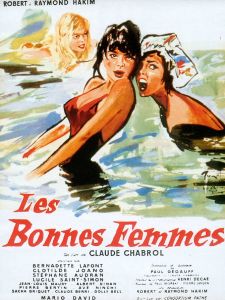
Les Bonnes Femmes, dir. Claude Chabrol, 1961


Having encountered early Chabrol once before, in ostensibly the first Nouvelle Vague film, Le Beau Serge, I thought I knew what to expect from Les Bonnes Femmes. I was wrong- in fact, I was surprised by the power and shock of it- an unsettling force that grows in unusual ways through gut-wrenching tonal shifts, and lingers in the viewer's memory. The bulk of the film treads the pleasurable, good times terrain of some early New Wave films (A Woman is a Woman, Brigitte et Brigitte), or in its anarchic jaded shopgirl feel, Chytilova's Daisies. Yet bookending this episodic play of love and work are two acts of patriarchal violence- an alluded rape, and an unambiguous murder at the hands of a stalker. The rape troubles the middle portion of the film, but without souring its comedic delight. With one of the women's murder, however, the entire narrative is thrown into confusion retrospectively, playing out with the impact of a fist in the stomach (not unlike the horrible attack that closes Breillat's Fat Girl.) A doe-eyed innocent murdered, and the fates of the other 3 protagonists abandoned, Chabrol segues to a dreamy coda that clarifies theme while furthering tonal confusion. An unknown woman sits alone in a dance hall, her face in shadows, under the narcotic trance of a mirrored ball and band. A man approaches, seen only from behind, and takes her onto the dance floor, fulfilling her only social role- to be brought into the world, made whole, through the predatory desires of the male. Is this a proto-feminist film?


The first 15 minutes of Les Bonnes Femmes are perhaps its best, tightly composed and edited, and bristling with a pervasive city lights energy not unlike the opening sequence of Touch of Evil. Men purposefully wait under the neon lights of an emptying theater; a group of women emerge, one bids goodbye to her boyfriend; the two men get into a car and follow them; simultaneously, a motorcyclist tails them all. Is this a Hitchcockian suspense? Intrigue set in motion? Surprisingly, neither, but rather a pair of crude philanderers cruising for girls, the mysterious cyclist falling away from the scene, to turn up later in a seemingly less menacing role. It is a confusing and suspicious sequence for the audience, that raises one's guard, but not enough to alienate us from the gaudy pleasures of the nightclub, zoo, theater, and swimming pool to come. Chabrol spends the next hour charming us with these 4 likable working girls who share employment at a perpetually dead electronics store, before our suspicions are vindicated. All 3 men in the opening sequence will come to be revealed as villains- rapists, murderers, bullies, sadists, and liars.

This is not to say that the time we spend with Jacqueline, Jane, Ginette, and Rita is padding or extraneous to the darker themes the film leaves us with. On the contrary, it is entertaining and thought provoking enough in turn that the shock of Jacqueline's murder would be meaningless if it did not jolt us out of something so engrossing. Prefacing, in a sense, their victimization, is Chabrol's sympathetic portrait of working class life for young women- the boring, long hours of standing around and looking pretty in shops, the sexual harassment from bosses and delivery boys, immersion in the world of luxury- but luxury only attainable by pawning their bodies to men. The looming presence of clock faces suggests a collusion of capitalism and patriarchy, beyond which, heroically, the young can still dance along in search of love and happiness. Indeed the "fun and games," acted with spirit (especially by Bernadette Lafont as Jane) is what distinguishes Les Bonnes Femmes from other capitalism-as-prostitution films of the same time like Godard's Vivre Sa Vie; without the juxtaposition of comedy/tragedy, joviality/violence its main point of interest is lost. Our heroines tramping through the zoo, for instance, is on par with the best antics of Jules and Jim, Karina and Leaud. And it should not be thought, based on the bleak ending, that Chabrol is a cynic in matters of love. Starry-eyed romance may lead to Jacqueline's downfall, but she is hardly to be faulted for her desires; nor Jane for her free-spirited flings, Ginette her chanteuse ambitions, and Rita her engagement with a neurotic square.


Returning to the question of Les Bonnes Femmes as a feminist, or proto-feminist film; it's a tricky question without clear criteria (and also grappling with by what degrees this is determined by content, production, etc.), but there is a critique in the film of the ugly forms of violence and exploitation to which women are subjected. Men are brutal predators, whose veneer of charm eventually gives way to naked aggression. Those men that defy this description are given a small sliver of screen time (Jane's beau), or are controlling in other ways (Rita's fiancee.) Beyond this, a feminist critique becomes more dubious, tempered as it is by the obvious male pleasures of watching beautiful young women carry on in tight dresses and bathing suits. Chabrol's construction ducks in and out of ideas like a game, dropping characters unceremoniously, coaxing emotional investment to have it turned into stone, and making us witness to the murder of a naif before dumping us into a starlit dance hall dream. Its a bold way of making a film, and raises my estimation of the guy (although from what I read his subsequent work loses a sense of experimentation and play.)

Wednesday, September 12, 2007

Bach: Variations

A scenario for a film about Bach, in which the audience learns nothing at all about Bach.

1st Variation
A graphic designer is employed designing covers for Bach records. Actual LP records, not CDs; she inexplicably and idiosyncratically is involved in this in 2007, which is never explained. She works on enormous canvesses, in the open air ruins of buildings. She visits churches for inspiration; begins an aborted romance; agonizes over a cover for his Triple Concerto. Suddenly, her canvasses start to disappear...


2nd Variation
A documentary day in the life of three wingnuts, accompanied by the three movements of the Triple Concerto, one movement per subject. A montage of their conversations, rituals, habits, obsessions, encounters; presented without attempt for the music to interpret the subject, not the subject to interpret the spirit of the music. Three movements dispersed throughout the endurance of the film.

3rd Variation
The genealogical search for my Rodebach heritage, the closest I will ever come to the Bach legacy. Who was Augustus Rodebach, who immigrated to Michigan in the 1870's? Could I consider my great-great-grandfather a RodeBach? A Rode Bach? Exaggeration and lying in the service of this specious endeavor. Interviews with any other Bach variation namesakes.

A Thousand Clarinets, dir. Ján Rohác, 1964

4th Variation
BACH, the word, broken down and built back up- taxi CAB; sheep BAH; broken BAC; talentless HAC; crow CAH. Linguistic play with the typed word, over detourned images from Bach film moments: Chronicle of Anna Magdalena Bach, A Thousand Clarinets, etc.


5th Variation

The public performance of Bach in unexpected circumstances: a punk show, outside a chicken processing plant for the workers, amongst tailgating football fans. Open to the collective improvisation of a hostile, appreciative, or confused audience.

Tuesday, September 11, 2007

Sunless

Sans Soleil, dir. Chris Marker, 1983

"Who remembers all that? History throws its empty bottles out the window."

On Sunday night we watched Sans Soleil from the New Yorker VHS release, which probably looked close to how it should given that it was filmed on 16mm. Any summary will fail to capture the depth of a Marker film, but briefly, a woman reads letters, ostensibly from whoever captured the images we see from a number of locations. This narrative gloss is quickly betrayed through the philosophical and historical musings that mark this to be an essay film, populated not by characters but by ideas loose in the world. Contemporary Japan occupies the film's center, but Marker's movement is not bounded by time or space, but by association, contrast, and the occasional non sequiter ("did you know there are emus in the Ile de France?") Japan had featured in his oeuvre before- the 1965 biographical short Le Mystère Koumiko- and there's a familiarity with the place that colors the content. Although he does dip into defining national moments, World War II and the Heian period, for instance, his exploration is far more personal, seemingly following interest and chance rather than reaching for a composite. Light is thrown into the sunless corners of Japanese culture: ceremonies, streets, tv, sex museums, outcast bums, video games, department stores, leftist demonstrations. Although the narrator sometimes reads from the letters sweeping generalizations, what we come to learn about this place and the others chronicled comes fragmented, at times contradictory.

Sans Soleil
, then, evokes early post-modernity in its fractured style and impressionistic portrait of post-industrial capitalism and underdevelopment in close, uncertain proximity on the screen. Post-colonial Africa serves as Marker's foil to technocratic Japan. Here the letters dwell far more on the past, the disappointing aftermath of socialist national liberation movements in the developing world, as mediated by extensive documentary footage. There are other travels, to San Francisco in search of Vertigo landmarks, to France with it's idiosyncratic emus, and the poignant bookends shot in Iceland. Leading the letter writer is the unrelenting theme of memory and image- Do images constitute history, or is it the other way around? How does memory use the image, and what are the implications of the image being used to dance across time and the surface of the world as Marker does?

How can I comment much more on Sans Soleil? On the internet alone there are pages upon pages of interpretation by people who've spent a lot more time with it then I have, or have a richer theoretical background. Instead, I'll just encourage everyone to make it a priority to see it soon, and give some brief thoughts as to why. To begin with, if my description sounds daunting, be comforted that Marker approaches his work with a sense of humor and compassion. Cats, dogs, children, even emus are his muses, and are treated as an essential part of the world, not to be trampled by history. Indeed, they are essential to our lives and memory. From an early scene:


"He wrote me that in the suburbs of Tokyo there is a temple consecrated to cats. I wish I could convey to you the simplicity—the lack of affectation—of this couple who had come to place an inscribed wooden slat in the cat cemetery so their cat Tora would be protected. No she wasn't dead, only run away. But on the day of her death no one would know how to pray for her, how to intercede with death so that he would call her by her right name. So they had to come there, both of them, under the rain, to perform the rite that would repair the web of time where it had been broken."

Later, however, the cat's name Tora is linked to the Japanese attack on Pearl Harbor- "Tora! Tora! Tora!" Even when the world is shown at its most ugly, and in the narrator's words "
history only tastes bitter to those who expected it to be sugar coated," it is in the context of an always guardedly hopeful compassion. Gut-wrenching footage of a giraffe being slaughtered, guerrilla warfare, kamikaze missions; everything has it's place, so it seems, but Marker makes no room for exploitative imagery. There may be room for faulting Sans Soleil when it reverts to anthropological language for commentary. For example: "He used to write me from Africa. He contrasted African time to European time, and also to Asian time. He said that in the 19th century mankind had come to terms with space, and that the great question of the 20th was the coexistence of different concepts of time."

Then again, according to the thin fictional veneer, this is not Marker himself speaking, but the fictional filmmaker speaking through his letters to the narrator. Who is this voice who is speaking to us, explaining or problematizing the stream of images? I'll leave it to the grad students to work on this one.


Another fascinating element of the film is the use of video manipulation, associated both with experimental art and mass-produced video games, to abstract and change images. A Japanese friend demonstrates their techniques, which they call "the Zone," a reference to Tarkovsky's Stalker, reducing film to moving shapes of color: "images, not the portable and compact form of an already inaccessible reality." As the film progresses, it seems to inhabit more and more this Zone, or at least becomes obsessed with the technical means and the results it produces. The now archaic manual pins and switches used to create these pure images take on an architectural significance, almost like the ad-covered buildings of Japan channeling the human subjects in the street. Aside from its obvious thematic significance, the aesthetic impact is awesome, especially in our digitally saturated culture where computerized illusion is the norm. The radical potential of manipulated video work such as this doesn't seem to get its due much any more; but, like Godard and Mieville's video techniques in features like Numero Deux and Here and Elsewhere, Sans Soleil's intellectual interaction with "the Zone" signals a trajectory of experimentation that has unfortunately been eclipsed by CGI sleight of hand.

I view everything in a new light since starting to work on my own movie. In Sans Soleil, the autonomy of sound and image, cut loose from each other and stitched back together (with an edging of ambiguity) by the narrator-medium, struck me. Marker's collection of images and non-corresponding sounds could potentially have been constructed into a complete film, or any number of shorter or longer projects. His technique, of course, is genius here, but what is to prevent anyone to go out with any primitive equipment (Marker here used 16 mm and frequently degraded the image electronically), record their world, and make something out of it to share? In developing the film, I've planned several scenes reminiscent of Marker's, with documentary footage and found images overlaid by found sounds and disparate narration. Sans Soleil showed the plausibility of this approach, and its pitfalls. Namely, the ideas need to be there to upgrade the images (by contextualizing, reframing, problematizing), or the images and sounds need to be remarkable, without the need of commentary.

Sans Soleil was not my first encounter with Marker; I'd previously seen his far longer and more ponderous work on the fate of the revolutionary wave of the late 60's, Grin Without a Cat, as well as earlier shorts Sunday in Peking and The Koumiko Mystery. Interestingly enough, those latter two I received on a DVD-R from a friend. We went to watch them, but found them recorded without sound. Koumiko had subtitles, but our Sunday outing in revolutionary China was dead silent. As a solution, we put on Ornette Coleman's Free Jazz, and the collaboration worked quite well. Marker's latest, The Case of the Grinning Cat got a short theatrical run in New York, but as far as I know hasn't made it to DVD- it's apparently an attempt to pick up the threads of Grin Without a Cat for the Iraq War generation, with a humorous exploration of Marker's favorite animal- the cat- in Parisian street art.