Wednesday, May 19, 2010
Don't Fuck the Boss!
"We live like students," Frédéric declares in L'amour, and indeed he and his adorable wife Hélène are a tasteful and understated bourgeois couple, quiet and content in their small world of cutting the pages of books and slightly animated dinner parties. Not like the students who animated the radical upheaval of May '68, however, no, not like those students at all. We even half believe Frédéric when he states that the objects of his horny stares are merely "extensions of his wife's beauty." Yet stare he does, pathetically channeling his repression into bizarre fantasies of seducing passersby with a glowing medallion. Later, he will flatly admit that marriage has robbed him of any actual ability to seduce. A petty rebel, Frédéric finds pleasure in sticking it to the business world by eating at strange hours, affecting non-sexist relations with his pretty young secretaries, eschewing business attire conventions. From our vantage point in the present, we may locate the origins of the current bizarre convergence of political correctness and corporate culture in this pathetic figure. This reading of Frédéric is against the grain of Rohmer's intent, one would think. His protagonist is an everyman, tormented by desire, yes, but ultimately decent and, as we shall see, capable of acts of redemption and transcendence. Unlike Tanner's Paul, Frédéric commands our sympathy, he suffers quietly, and just as quietly overcomes in a moment of grace. Given the director and trajectory of this cycle of films, it is not surprising the blatantly Catholic overtones. Rohmer is a master of characterization and emotional inflection (rarely is there anything approaching hysteria or rage in his films), and there is real dramatic and ethical heft in his broaching of the universal crises of love, fidelity, desire. These concerns may be left aside for the moment, for a big, brassy woman demands our attention immediately.
Enter Chloé, a primal force in blue jeans, pants suit, or baby doll dress (played brilliantly by Zouzou) From her first entrance, she upsets the unspoken hierarchies in Frédéric's little world. The two demure secretaries of the office defer to Frédéric's every wish in obedience to the habits of waged labor, responding appropriately to the little flirtations and glances of the boss, because he is the boss, a banal patriarchal relationship par excellence. When Chloé shows up unannounced at his office, Frédéric is clearly uneasy at her presence, an attractive woman in the world of commanding businessmen, unbeholden to his whims (decent and restrained as they may be.) He reacts coldly to his old friend's girl, but the sexual frisson is immediately palpable. Not only is Chloé a liberated woman, unabashedly recounting her ability to wield her sexuality for her own ends, she also has forsworn obedience to the capitalist economic order, submitting to wage labor only sporadically and moving from place to place as the spirit takes her. The extended game of seduction she initiates with Frédéric is not just a matter of individual morality. It is a strategic struggle of wills between opposing orders, a codified, patriarchal, pseudo-egalitarian consumer capitalism versus the destablizing forces unleashed in the 1960's- feminism, the challenge to waged work, new demands for personal freedoms, critiques of social conformity. Rohmer would seem at times to sense an opening for this interpretation, and cautions against it through character dialogue. Chloé states that she wishes she too was bourgeois, but its easy to decipher a teasing remark from this vulgar, unfettered, confrontational woman. We may characterize her as lumpenbourgeoisie, at best. Some might have regarded the revolting students of '68 in the same terms; it is a subclass that has produced many great anarchists.
It is significant in comparing the two films in question to consider the treatment of work and the workplace. Frédéric's bourgeois office, his site of command and power, is breached repeatedly by Chloé, who casually occupies it, smoking, sitting on tables, slouching in a chair. In capturing this stronghold, the remainder of the struggle is pre-ordained. Indeed, in a predictable inversion, Frédéric verbally commits to adultery with Chloé in the basement of her work place, a modest boutique, a stronghold of the feminine and petty-bourgeois. Le milieu's Adriana is spotted by her pursuer Paul working as a waitress in a provincial train station cafe, submitting to the small degradations of unwanted touches and verbal harassment by the customers. She is a working-class woman, and on top of that an immigrant, in a workplace openly characterized by humiliating submission to men. Paul, in spite of the gentlemanly nature of his overtures, is hewing to the essential pattern of patriarchal behavior in pursuit of Adriana. Whereas in Rohmer's film the male protagonist in under attack "unjustly," or in a way that upsets the established norms, in Le milieu Paul is merely following the imperatives of a patriarchal order. It should be noted that while Adriana accepts on her own terms, and is not a simple victim, Tanner takes great pains to underscore the marginality and vulnerability of her position.
Paul is a far less likable figure than Frédéric, I would argue quite intentionally so, despite showing psychological weakness, flashes of pedestrian decency, etc. For one, we never are shown his wife and children, sequestered in a well-appointed Alpine home. He is also involved in the unsavory business of politics, running as a candidate for a bland technocratic law-and-order party of the right. He is an apathetic candidate, drafted solely for his image as a pillar of bourgeois society: a competent manager, family man, native son. The poisonous tension sustaining Le milieu derives from the systematic revelation of every one of these identities as empty hypocrisy. For who does Paul court at a wayside cafe while he should have been campaigning? Adriana- beautiful but scarred (literally), a working-class immigrant from Italy, with a family history of work place militancy. Unlike Chloé she has no interest in games, but does harbor a deep well of emotional strength with which to navigate Paul's maneuvers. And unlike L'amour, Tanner does permit flashes of genuine love and affection between the man and his mistress. Rohmer has a real feel and concern for love, but often in his precisely plotted films, the result resembles a game of chess, balanced and strategic. The relationship of Le milieu suggests an organic realism, yet one haunted by an explosive contradiction, a fatal imbalance emerging from the core of the lovers' subjectivities.
Le milieu's concluding voiceover obliquely accounts for the end of Paul and Adriana's affair with a vague humanistic note on diverging lives. An attentive viewer can not miss the real reason, which is immanent in the characters themselves, emerges slowly in the course of their affair, and is brilliantly, forcefully illustrated in the final sequences. En route to a tryst at a swank hotel, Paul rehearses a speech, full of dull platitudes of social cohesion and order. Adriana interrupts him, correcting his conservative nonsense. Later, she refuses to stay the night in such luxury, demanding to be returned to her tiny apartment to make love. The class gap between lovers lies latent while passions run high, even as the power dynamics of their relationship become more apparent. To Paul, once he has seduced Adriana, she is his, forever, and should be brought into the periphery of his false bourgeois world of small luxury and patriarchal "love." His worldview is blindly positivist, naive yet iron in its enforcement of normality. Indeed, we find some coincidence between the worldviews of the character Paul and the director Rohmer. Unfortunately, Paul is character not creator, and reacts with incredulity when Adriana tires of his narcissism and hypocrisy. Even as their trysts become an open secret around town, Paul continues to campaign, much to the dismay of the party bosses.
On the morrow of his defeat, Paul retreats to Adriana, expecting consoling and more besides. He is shocked when Adriana shortly announces her departure, given the death of the cafe owner. What is the motivation of her decision, her decisive break with her lover? Significantly, it comes on the heels of a work place change- a familiar lever of working class decision, as she had noted earlier regarding her own family history. Registering as well is a certain disgust with Paul's casual disregard of his election loss- a reaffirming of his trivial engagement with the world, of the hypocritical gap between the speeches he can convincingly deliver and the reality of his single-minded desires. It is a masterfully ambiguous moment in the narrative by Tanner; by allowing space for the mysteries of individual agency, we approach the power of Rohmer's story-telling. Or, I propose, Tanner draws explicit attention to the embodiment of the contradictions of capitalism in Paul and Adriana's affair, but, like these contradictions writ large, one never knows where, when, and how they will resolve, explode, or be displaced. When the didactic thrust of the film resumes and drives it to conclusion, the political meaning crystallizes in a pair of matching scenes detailing the lives, post-affair, of the couple. Paul is back at work, surveying the workings of his factory in technical dress and authoritative demeanor. We then see Adriana at work in a factory in another city. Walking down the aisle is a supervisor, in dress and demeanor nearly identical to Paul as he was just shown. After the brief, unsustainable illusion of sexual dalliance, Paul and Adriana have returned to their essential lots in life: privilege and authority for the former, alienation and exploitation for the latter. Although Adriana may be seen to have conducted the affair of her own volition, for her own ends, she ultimately returns to her structurally imposed position as an immigrant working-class woman. She has been sleeping with the boss, an embodiment of the ruling class if not the same individual. Paul, pleasure won if broken-hearted, appears to have lost little. Like Frédéric, he can safely return to the bourgeois bosom after dipping his feet in the exhilerating waters of another Europe.
From the fate of the couples in these parallel narratives, we have distinct injunctions issued to their respective protagonists. "Don't fuck!" Frédéric is commanded by his moral tale. Adriana is made to understand a supplemented proscription, "Don't fuck the boss!"
***
The salience of Frédéric's proscription in the contemporary zeitgeist is most aptly seen in the Hollywood reinterpretation of L'amour l'apres-midi as the 2007 Chris Rock vehicle I Think I Love My Wife. We should not hold our breath for a multiplex release of I Think I Hate My Class Enemy, but return instead to our initial situating of the two films in the context of early-70's Europe. It is a period described by Tanner in Le milieu's voiceover as "normalization;" Alain Badiou has described the movement more colorfully as the "Restoration." Within this retrenchment of the established order, post the upheaval of the 1960s, two general trends may be identified. First, the beating back of radical groups and social movements, a process more successful in some places than others. Notably, the 1970's saw an intensification, not diminishing, of struggle in Italy- an enticing point of significance in Le milieu, which dramatizes the emigration of class-conscious Italian Adriana to the more pacified nation of Switzerland. Second, the recuperation and integration of oppositional cultural and social formations into the circulation of capitalism- both in the fulfillment of certain moderate demands, and in the proliferation of commodifiable identities, especially youth subcultures. Is there not a certain odor of this hanging about L'amour, with its veneer of risque fashion and new sexual sensibilities, but absolute avoidance of the political?
Tanner's work of the decade is dominated by the theme of 60s subjectivities cut adrift in the normalization of the 70s, in the demoralizing return of business as usual. "What now?" is the implicit question dominating the drama of nearly every character. Note, for instance, the unresolved fate of Adriana at the conclusion of Le milieu, in contrast to the happy return of Frédéric to the timeless, unchanging family unit in L'amour. Le milieu thematizes normalization in more formal ways as well. Calendar date intertitles precede most scenes, a reminder both of the historical specificity of the moment, and the ever increasing distance from the event of '68, the grinding dead time of depoliticized existence, the time of work and capital accumulation. There is also a potent visual trope of a Swiss country field, alternatively fallow in winter and sun-splashed in summer. The symbolic gesture towards the immense power of change on a place and people is self-evident. Finally, the materialist marking at the film's onset, acknowledging both in mise en scene and voiceover the materiality of the film as situated artistic intervention and commodity, as product of a specific place and time.
Where then does that leave us to consider L'amour in the context of normalization? I argue above for a reading of Chloé as an embodiment of some of the oppositional movements of the 60s, but in the form of a sexual predator that rationalizes her to an extent in Rohmer's ahistorical worldview. Rohmer does obliquely acknowledge the antagonisms of preceding years, but not the process of normalization. Rather, what appears on the surface of his film is recuperated debris of a capitalist counteroffensive, namely sexual mores, fashion, etc. As an aside, it is fascinating to review in Rohmer's work post L'amour numerous commendable period films that reveal a keen appreciation for the subtleties of history- be it in the stylized Medievalism of Perceval, or the perceptive Popular Front spy thriller Triple Agent. If only we could all be like Frédéric, and only have to furrow our brows to consider the singular quandary of whether or not to keep our pants on.
Tuesday, September 15, 2009
Forman's Faces

This representative shot from Loves of a Blonde shows a typical Forman composition: a tight arrangement around one or several inert bodies, usually from the waist up, in which the facial expressions of the actors subtly push along a narrative in lieu of a continuous expository dialogue. In this instance, three young factory girls find themselves at a mixer to welcome a troop of middle-aged reservist soldiers to their drab provincial town. Three fumbling soldiers eye them across the room, and this one still expresses almost entirely their half-bemused, half-curious response. This sequence forms a bulk of the film's middle part, and like a silent film can be understood with the subtitles turned off. As girls and men look warily at their own and their awkward opposites, the audience is presented with a rotation of 9 distinct faces in unison or alone, and a coterie of anonymous mugs in various states tending toward the banal. An emotional force of small narratives emerges through these precise montages- a technique used in a similar way in the elongated, farcical party that constitutes The Firemen's Ball.
And the faces themselves? Perhaps the best can be politely called provincially pretty, but Forman's true delight at this time is a density of faces that express the full variety of eye, ear, nose, hair, and mouth variations in the Czech hinterlands. This holds his work apart from both silent film's adoration of expressive beauty and Hollywood's star fawning. Rather, there's a certain egalitarian beauty of "the people" broadly distributed over each individual face, such that one feels something of an appreciation of the true community in which these slight films are set, even as the physical locations are limited. It should be noted that Forman is not here obsessed with the face as such (as opposed to Warhol's screen tests, for instance), but rather deftly utilizes it for narrative and, I think, political/ethical purposes. The tension between individual and social interest (The Firemen's Ball), or economy and the erotic (Loves of a Blonde) take shape as much through facial tics as plotting. Despite the slightness of both films, a plethora of small themes and micro-narratives play out in the cinematic space between glances and smiles. This is not to say that Forman dispenses with story or some conventions of form (these are social satires, not experimental adventures), but rather to point to this particular technique as what I feel distinguishes these films and places them among the best of the late 1960s.
But what is so different in Forman's faces, then, say the Hollywood close-up? Whereas the close-up usually conveys a heightened emotional state in contrast to physical action or to punctuate important moments of narrative, Forman's faces seem to need no such justification. Indeed, they typically express the more banal emotions- boredom, awkwardness, embarassment, mild disappointment, slight irritation or anxiety, and petty joys of conversation. And, as in life, they hide as much as they reveal, even when what they have to hide may be of no importance. This prevents easy generic typing and colors these films with unique characterizations. Although we can recognize a few types- the anxious, bumbling authorities in both films (fireman and foreman), for instance, how are we to characterize Loves of a Blonde's Andula and friends? It is a testament to Forman's remarkable direction of expression that we feel for the characters of these brief films without really getting to know them. Every understated face at the party has a story to tell, it seems, and Forman has merely picked a few at random to spin out in past and future.

Taking Off- Forman's first American film- begins with a variation of his face forward technique. Throughout the title sequence and in subsequent bits, auditioners face the camera against a black background and sing, sing, sing! The second such sequence features dozens of young female crooners slogging their way through "Lets Get a Little Sentimental." Its an intensification of the his Czech faces- more rapidly sequenced, framed squarely against a black background- couched within a neat construct that introduces us to the wayward youngster Jeannie and presents the film's general theme of the counterculture's intrusion into traditional American society. What is not abandoned is Forman's determined embrace of facial variety- in this example the mean which could perhaps be averaged out as outer borough pretty. Significantly, these faces are performing, striving- a transposition perhaps of the overriding Czech communist anxiety for social harmony to the more American liberal concerns of individualist achievement and the mass media complex.
Nifty formal and aesthetic moves, but political as well. The lack of glamour and expressive beauty in Forman's faces is an expression of egalitarian solidarity, even more powerful in that it subverts the officially egalitarian dogma of Czech communism, and the anti-egalitarian spirit of American individualism. While perhaps taking a cue from socialist realism or even Italian neo-realism, Forman's faces are not mere vehicles for blunt politics or the weather-worn skin of workerism. Its a generous humanism, one that embraces kind-of-pretty shy young girls as proletariat and would-be glamour pusses as proletariat in denial. As is often noted, while social satire, Forman's films are almost never mocking, and certainly never cruel. As each of his faces has its flaws, every person, regardless of their ideological placement, has their foibles. It is good, these films imply, to be amongst these people and their faults, their small beauties and small ugliness. It is debatable how much this ethic continued through Forman's later films, but most certainly his faces largely disappeared into the rush of the conventional film format.

Monday, August 17, 2009
Very Nice, This Belgium

What is Belgium? What is its character, its flavor, aside from European bureaucracy and dikes? Dikes, right, or is that Holland? What I know of the place from the screen is fairly dour- Jeanne Dielmann's frightful frigidness, The Man Who Cut His Hair Short's ugly psychic landscape. Toute une nuit may have spiced up the mix, but the backdrop remained uninspiring. And now we have the Dardennes to seal the deal for provincial Americans who live by the screen- Belgium is nothing but an industrial plant peopled by Europe's morally challenged marginals, strange folk some of who may speak French, but do very unsophisticated things to their kin and themselves.
It just so happens that my two most recent theatrical viewings were crafted by Belgians, but one by a filmmaker no longer associated with that flat nation. The truly Belgian film, the Dardennes' newest Lorna's Silence, strikes at the heart of the European soul, while Agnes Varda's Beaches of Agnes lolls on its beaches and avenues.
Lorna's Silence trolls familiar ground for the Dardenne brothers, but I believe dramatizes the conflict between humanist ethics and capitalism's profit motive more powerfully than their previous works (granted, as several reviewers have pointed out, the narrative is more contrived and plotted.) Lorna stands at the crux of the contemporary European soul, half way between the promise of egalitarian liberty and slavery to an underworld increasingly integrated with the official economy. Although this Albanian immigrant in Belgium sees glimpses of the utopian, unified continent- in her ability to emigrate, possibly open a small business, seek protection from a welfare state (as when she is granted a speedy divorce)- she is not a true citizen of anything called Europe. Rather, she is a reified commodity- a source of profit for human traffickers and a name on paper that will hopefully be lost in bureaucratic shuffle. Centuries after the Enlightenment revolutions, the soul of Europe remains locked in struggle between the championed ideal of the free individual and the body reduced to commodity. Lorna's Silence, then, works most powerfully as a critique of reification, of the betrayal of the revolutionary-liberal tradition by capitalism's insidious commodification of citizenship and citizen alike.
The Dardenne brothers' realist style is matched by their insistence on ethical decision as more than plot device, an approach alien to Hollywood. Lorna's decision comes mid-film. Claudy is her husband of convenience, a shiftless junkie, who is marked by Lorna's trafficker to be disposed of by way of a lethal overdose. Despite their emotionless business-like sharing of an apartment, Lorna tries to stall for time until a divorce can go through, thereby saving his life. Her attempt to save Claudy while preserving her self-interested immigration scheme animates this section of the narrative. One night, she comes home to find a dealer in their apartment, with Claudy, who has kicked the habit, fiending for a hit. Brazenly, Lorna locks the dealer out, throws the key out of the window, and, shockingly, strips silently and offers herself to Claudy. Her insertion of bodily affection into this chain of casual cruelty and exploitation is a supreme ethical gesture, daring but curious. Why is it sex, that most crassly demeaned human experience, that which disrupts the functioning of the capitalist imperative? It's preeminent place is a sly surprise in Lorna's Silence, one that injects an air of the mystic and mythic into the film's resolutely quotidian comings and goings.
The trauma of Claudy's eventual murder is internalized by the still silent Lorna in a phantom fetus she imagines to be the result of their tryst. Despite her attempts to move forward with her role in the trafficking scheme and small dreams of entrepreneurship, Lorna has irreversibly tripped up the chain of exploitation. Although her gesture of solidarity with Claudy, that of recognizing him as a human worthy by that dent of life and not a disposable junkie, has ultimately failed, the pains from her womb undermine the plan to marry a Russian thug. As all her plans unravel, she is abandoned by all and prepared for either her deportation or death. Lorna flees her captors, but it is an uncertain
escape; the film closes on her in an abadoned cabin, swearing to her unborn child to protect them both. Allusions to other mysterious, virtuous pregnancies are unavoidable. After all, in a similar situation, shunned and desperate, Mary gave birth to Jesus in rough shelter. Lorna, ironically, has become like a virgin after copulation with Claudy, purified of the tainted money relations of the underworld. Perhaps she falls somewhere between the virtuous virgin of The Marquise of O. and the decidedly unvirtuous Queen Mary, killed by a phantom pregnancy tumor.
In another interesting inversion, the film's ethical impulse comes from Lorna, an Eastern European character, amidst Western Europeans corrupted by the scrappy pursuit of money. This challenges the long-standing geographical narrative of the Eastern and slavic nations of the continent only slowly emerging from a natural proclivity to servility and corruption, be it to feudal lords, Turks, or Communist dictators, and lagging behind the progressive prosperity of the West. The "spirit of capitalism" is capable of awfully vile things, Protestant or not.
Agnes Varda, although associated with France in every way, was actually born Belgian, as her autobiographical essay film, The Beaches of Agnes, tells. True to its title, the lively octogenarian Varda narrates a collage of her life and loves, which all lead back to the sea, suggested as the font of her imagination. The film works both as a personalized account in documentary fashion of her life and work, and as a sly, engaging exploration of creative existence broadly considered, in the manner of her life long friend Chris Marker (who appears in the form of a cartoon cat, why not?) Varda's considerable charm and intuition for successful cinematic experiments (she is clearly having a blast with the camera and montage after all these years!) raise it above narcissistic nostalgia to a true work of art, if a humble one. It is a work that will not be considered an after thought to her career, destined to DVD extra menus, but an essential part of her ouevre.
Wednesday, August 12, 2009
Down and Out in Late Capitalist America
Its a crude schema, for sure, but I present it because I do think there is something to "the American dream" beyond its ideological utility. There's a whiff of egalitarian possibility to it that can be deployed by both left (the Communist Party's "working class Americanism", the contemporary labor movement's rhetorical emphasis on middle class lifestyles) and right (the fable of a return to innocence via conservative morality). Needless to say, the material conditions for the dream have long since been destroyed in the neo-liberal turn (off-shoring American industry, destruction of organized labor, defunding social services, privatization.) This is another story, the very narrative we find ourselves in now, where the fumes of the dream evaporate into the sober tragedy of foreclosed subdivisions, historic unemployment, and the financial voodoo of Wall Street. Modern capitalism of steel and stuff is long gone in the U S of A. Now we stumble through a late capitalism of spectacle and speculation, awaiting the next crisis.
No one told Hollywood. New American Cinema's brief 70s afterglow made some room for bold explorations of the dream gone bust- Barbara Loden's recently rechampioned Wanda is my immediate association- only to fade into the banality of the 80s and 90s. This is not to say that socioeconomic reality is ignored by Hollywood, which has to make its requisite prestige pics and occasionally grasp for a sympathetic, verite gloss of the poor and downtrodden. Overwhelmingly, however, American society is schizophrenically portrayed either as a smooth, prosperous backdrop for various romantic foibles and heroics, or as a spectacularly dysfunctional country on the razor's edge of dystopia. Neither approach critically explores society. American cinema by and large has no incentive do so when the audience growth markets appear to be torture pics and postmodern quirk.
And so imagine my shock to have earlier this year viewed two contemporary American films in a single week that both attempt a critical, challenging portrait of late capitalist America. Its protagonists change their clothing in gas station bathrooms, and it is not sexy; submit themselves to humiliating acts of violence, and it is not funny. Indeed, the extreme sobriety of The Wrestler and Wendy and Lucy indicate what a grim task dissecting the decomposing corpse of the American dream must be for a serious filmmaker.
I'll examine the 2 films through their protagonists, using the scheme Wendy->adult experience in late capitalist America->Randy "The Ram". Kelly Reichart astutely casts Michelle Williams as a vaguely hipster-chic, scrappy, and attractive young Wendy who, although bearing an at times cynical attitude, is nonetheless fresh-faced and naive. Wendy and Lucy follows her through several days flat broke and busted somewhere in Oregon, en route to a supposed canning job in Alaska. Stylistically sparse, this is damn well not some sort of contemporary On the Road or Easy Rider. Wendy is not searching for herself, or for America, but for a paycheck. Neorealist allusions, especially to The Bicycle Thief abound. Like that film's unemployed protagonist whose stolen bicycle sets off a downward spiral of degradation, Wendy's bad luck dooms her within days to absolute penury, including the loss of her precious pet and only companion, her dog Lucy. Poverty and homelessness are mere missteps away from anyone, we are shown, even for the hip young things Hollywood pampers and adores. Pluck is not enough, and social ills can not be pathologized in inner city minorities. Wendy is a benchmark, a true hipster bum- not a slacker lost in a pot-clouded malaise a la Kevin Jackson or Richard Linklater, or an over-educated mumblecorer, but a victim of the cold, banal mechanations of the economy. The vagaries of capitalist society in crisis, corporate flights from existing communities and livelihoods, stimy her no matter her significant reserves of resolve.
Generally then, Wendy's experience is an anecdote contra the American dream. In its specifics, it portrays a very contemporary type of alienation- that of outwardly hip, intelligent, light-skinned young people from not only from personal fulfillment, but from the very means of subsistence. If we can chart the rising affluence of Italy in the evolution of its cinema from the material deprivation concerning the Neorealists to the spiritual alienation of Antonioni's characters, then we can likewise see in Wendy and Lucy the fall from relative affluence even seen in, say, the Singles of 16 years previous.
And perhaps the Singles/Wendy and Lucy example has more to it. The geography of Wendy and Lucy, although certainly originating in director Reichart's connection to the northwest, is significant for our analysis. Wendy has fled Indiana, which calls home reveal to be an unhappy place personally as well as economically. Indiana recalls visions of the heartland American dream, although its also part of the Rust Belt, its cities and towns convulsing from the death throes of the manufacturing economy. Significantly, she breaks down in Oregon, presumably near Portland, one of the capitals of the so-called "creative class", the heroes of a new post-modern, green economy. The cultural cache of Portland is well known. In addition to being a hipster haven, it is, like similarly touted places such as Austin, San Francisco, and Seattle, a hoped-for capital generator in an otherwise bleak national economic landscape. Yet Wendy finds it as inhospitable as anywhere else, bereft of opportunity and indifferent to her tough charm, perhaps not hip enough to find an outlet for commodification. It is, of course, a well-known reality that Oregon's economy sucks, and the state has long tried to persuade folks to visit, but not move there (echoes of the Joad family arriving in California?) Finally, Wendy heads north to the wilds of Alaska in a freight car, like the hobos of yore. Alaska in the popular imagination remains the last American frontier, a vast wilderness not entirely integrated into American capitalism, and perhaps for that reason appearing as a dim beacon of hope for the down and out of the lower 48. This myth, popularized by Jack London, has not diminished much; however, we can not help but dread as the credits role what miserable fate likely awaits Wendy there.
Wendy's America is one of no jobs and no opportunities, a physically ugly post-sprawl landscape of ubiquitous stand-alone drug stores and failing neighborhoods. Its people are worn, suspicious, yet generous in a pitch, as Wendy discovers in the saintly yet pathetic gestures of the elderly security guard she encounters. Unlike the guardian angels of old- those father figures, be it police officer or kindly stranger, who provide the crucial link that brings the struggling protagonist back into meritocratic society- Wally the guard's ultimate effort for Wendy is absolutely impotent (a fistful of crumpled small bills), for he too is just a paycheck away from destitution. But in a film as bleak and unsentimental as Wendy and Lucy, a little of the milk of human kindness goes a long way.
The levelling of the late capitalist American landscape moves us seamlessly from Wendy's anonymous streets to the same worn storefronts and broken concrete parking lots of Randy the Ram's New Jersey. For all its razzle dazzle veneer, The Wrestler's tone is remarkably similar to that of Wendy and Lucy. If Wendy is the still beautiful naif yet to feel the full grind of the machine, Mickey Rourke's Randy is the mangled lump of flesh that it has spit out. Wendy's ordeal still unfolds on the tension between the atmosphere of possibility (beautifully enhanced by the film's simple and haunting hummed theme) and the slog of bureaucratic indifference. Randy's struggle is dramatized on the body itself, where not even the occasional snatches of northwestern beauty afforded to Wendy can adorn.
It remains unclear in the narrative what drove Randy to the ring, but over several decades The Ram- the professional showman wrestler- has subsumed any previous identity. What Randy and his peers understand, but the fans don't, is that wrestling is a job like any other in capitalist society, with its hierarchies, potential rewards, and probable insecurity. While everyone knows pro wrestling is fake, Aronofsky's effort to absolutely strip it of spectacle is admirable. Of course, the director's over-reliance on conventional narrative devices, especially the redemption theme played out alternately with his estranged daughter and stripper love interest, builds up another form of spectacle. Fortunately we can leave The Wrestler's faults aside for this analysis.
In Randy the Ram we see an exaggerated account of the role of work and the worker. The slog of the punch clock might be replaced by the ultraviolence of the squared circle, but the exploitation, alienation, and harm to the person are amply on display. Fortunately, many of us do not have to undergo being stapled or thrown onto shards of glass at the office, but these are apt metaphors for the absolute sacrificing of personal autonomy we surrender. Indeed, as the Ram's personal confusion and pain dramatizes, our very sense of self and identity is fractured in capitalist society; divided between the alienated time we sell our labor power, the time we have remaining to pursue alienated pleasures, and the potential, tantalizing possiblity that hovers above all of finally uniting the interests of self and society beyond waged exploitation. The late capitalist twist of The Wrestler's portrayal of work is what Randy does outside the ring. There is the second job at a supermarket, as well as petty self-promotion and flea marketing of the fragments of his fame. Indeed, the trend from the single-paycheck American dream to today is one of holding more and more lower waged jobs, and in the off-time speculating in small time entrepreurship on EBay or the interstate flea market. Randy and his damaged peers selling dvds and personal photos at a VFW Hall reminds one of nothing so much as the dismal yard sales dotting state highways in the rural south on saturday mornings- families trying to sell off worthless junk for grocery money. Wrestlers don't earn pensions, but then again, who does these days?
Aronofsky sharply dramatizes this fractured identity and the violence of even the most mundane workplace in the crucial scene in which Randy has quit the ring to work at a supermarket deli counter. To the imagined cheering of fans he emerges- through sheets of filthy plastic and to work behind the counter, serving not pain unto his opponents, but potato salad to elderly penny pinchers. Following a quick montage in which it seems Randy has found his rhythm shovelling salad and slicing meat, a customer recognizes him. He denies he's the Ram, but the question of identity broached, he slams a fist into the slicer, effectively ending his brief grocery vocation and forcing him back to the ring. Although his outburst is extreme in its bloodiness, the humiliations and occupational dangers of this type of service job are very real. From the mundane to the extreme, the deli counter to the spectacular entertainment sector, the postmodern worker has not escaped from the dangers of the industrial workplace, but has been stripped of the benefits and job security won there. It should be added that Randy's only emotional connection is made to a worker in a similarly precarious, body-oriented line, over which the threat of violence hangs- the stripper Cassidy.
Wendy and Randy, then, despite their differences, both find themselves on the precarious shit end of late capitalism. Petty hustling and theft, extreme risk-taking, marginalized roles in consumption and production- these are not exceptions to their existence, but absolutely necessary for survival. Reichart's approach is more naturalistic and sparse then Aronofsky's, but both owe something to the dour humanism of the Neorealists. As Wendy abandons Lucy to hop a lonely train North, one is reminded of the memorable ending to Vittorio De Sica's Umberto D., also involving a desperate title character, their dog and a train. Whereas De Sica's classic protagonist is a discarded old man whose sole canine companion saves him in a moment of grace from suicide by train, Wendy is separated from Lucy with no clear resolution. Without even the consolation of a long life well lived, she sets off, alone, a youth whose potential stands to be wasted in a cold place far away from home.
Tuesday, September 25, 2007
Deep End
Deep End (dir. Jerzy Skolimowski, 1970) is a dark coming of age drama set in drab working-class England, damp with misery and frustrated sexuality. Comparisons to Harold and Maude and Rushmore are common, but are apt mostly for narrative similarity. Whereas Wes Anderson operates in a postmodern pop culture dreamland, and Harold and Maude proclaims an anarchic new era of liberation, Deep End describes a society in deep distress and psychological confusion, even madness. Mike, its 15 year old working class protagonist, may share a good natured quirkiness with Harold and Max Fischer, but his fate is far darker, his sexual obsession with an older woman less love than naked lust. Thrust into an adult world unprepared, he finds a devious double standard where the young are sexually exploited but forbidden full access to adult sexuality. When Mike pursues this contradiction to its conclusion, tragedy is inevitable.
Skolimowski's sense of mise en scene and tonal construction is compelling. The decaying landscape of crumbling Victorian bathhouses, red light districts, and dingy subways make for a sober palette broken dramatically by the passionate, expressive reds and yellows of Susan, Mike's object of desire. Extensive hand held shots explore the landscape while keeping the characters distant, alienated, despite their occasional flirtatious moments. This distance is further marked by the screenplay and John Moulder-Brown's portrayal of Mike that perhaps takes on a glint of madness too early, and runs out of steam by the spectacular final swimming pool scene. I liked Deep End, which I think deserves the tag of a lost classic. Although the symbolic use of color was a bit tired (hadn't Godard already established that red paint is blood in front of a camera?) there was a earnestness here that is still refreshing. In all the stories of sexual obsession that fill the multiplexes year after year, one rarely finds this nuanced perspective; namely, that such a story can be told, with verve and sympathy, outside of an aestheticized world where hard bodies and serial killers bounce off each other like popcorn.
Strayhorn magazine was the screening sponsor. I don't know much about it, but from what I've been told its a new local magazine bringing to light obscure and out of print film, music, and art. Right on. To track down a bootleg copy of a great film, and take the time to schedule, publicize, and screen, is righteous and should fill rooms, especially if given a better night of the week. My only wish would be that Flicker would get a new screen without wanky creases, and correct the keystone distortion somehow.
Friday, September 21, 2007
Syndromes and a Cine
Take, for instance, last week’s scheduled run of Rear Window. In good faith, I assumed that they had acquired a print from the film’s theatrical re-release that I recall coming to the Manor in my high school or college days. I was prepared to pluck down $8, but on a whim I called ahead of time to confirm a 35mm screening, only to be told that it would actually be digitally projected from a run of the mill DVD release. I decided that I could watch a projected DVD at home, and of a film I’d not already seen, at that.
Ciné’s policy of DVD screenings is not always problematic- for a midnight movie, for instance, the ambience is lighter and more social, so a “cheap” format is acceptable (and I also understand that midnight shows can be cash cows for indie theaters.)
But Rear Window is a different story. Certainly many if not most in the audience were not watching this, an exceedingly popular and accessible movie, for the first time. Hitchcock is so familiar to most film goers that to charge full price for a screening indicates the opportunity to see them in their original, cinematic glory; a DVD projection for a classic film should not be charged for, or if so, only a few bucks, a la Tate Student Union theater. Perhaps I’d be more forgiving if their advertising included a note on presentation. Without even this, it seems like a cynical ploy to cheat viewers out of what they clearly have come to see. As a friend and Ciné employee noted, it’s like going to a concert and having the band put in their CD. While I can understand Ciné’s business imperative, if you have a gap in your scheduling and have to screen repertory digitally, why not dig up something more adventurous, less familiar- there’s over 100 years of cinema to pick from (with a warning to the public that’s about to lay an hour’s wages down.)
It’s easy to forget about all that when the following week Ciné brings to
The biggest rule to shatter is one of the West’s most essential: the expectation for a binary structure, symmetry, and repetition. Syndromes opens at a rural Thai hospital, sometime in the recent past or present. Surrounded by languid green fields and forests, the environment seeps into the behavior of the patients and staff- as they work or recuperate they tell stories, exchange folk remedies, play guitar, and feel their way towards love and grace. Eventually, the story focuses in somewhat on the young Dr. Toey who, to ward off a soldier’s awkward advances, points the film to another skeletal, digressive narrative, of her flirtatious relationship with an orchid grower. This story, or rather the fragments of time in this setting, comes to an end, but there’s still half of the movie left.
Then, we think we have Weerasethakul’s card- the story restarts, recreated almost scene by scene initially in another hospital, a high tech urban one of the present or near future. Although shots are reversed and the dialogue slightly different, we see the same actors in the same roles- the fresh army doctor, the cantankerous monk, the kind female doctor, the singing dentist. Yet after the initial sequence of shots, the symmetry crumbles, and we are led onto other paths- the new doctor’s possible relocation, a young patient’s corridor tennis practice, and the strange happenings in the dated basement of the building, including a prosthetics workshop and endless, ominous remodeling. The disappearance of a dialectical, logical game leaves the film open to the free play of memories, impressions, and seemingly unconnected scenes. To describe it as dream-like is inaccurate- Weerasethakul is not a surrealist or a freak-out artist. Avant garde is a more appropriate descriptor, but an avant garde of great humility and humanism; one that starts with quiet moments of the quotidian, building his work not to shock or confuse, but in a spirit of reverence and wonder. It is no surprise that much of the film was based on the memories of his doctor parents.
99% of contemporary films operate in a fairly closed and settled grammar that, while not always or necessarily bad, does little to expand the boundaries of cinema. Syndromes and a Century (like his previous Tropical Malady) is the 1% that confirms that cinema can and must remain a vibrant medium in the 21st century. It is a type of film-making that can surprise even the most hardened movie explorer, and will hopefully reach a wider audience upon DVD release. But, following the manner of Weerasethakul and to invoke for my own memory some of the most remarkable moments of the film, I’ll conclude not with clinical analysis, but with a list (from memory):
The blanched out color palette; going against conventional Western views of southeast Asia as a bright, colorful jungle paradise, the cinematography bleaches the sky white, and tones the verdant greens into paler tones.
We are treated to the uninterrupted performance of a festival guitarist- why not? A conventional film would deem this nonessential, distracting.
Matching shots in both “versions” of the story, both completely spell-binding but in absolutely different contexts: the solar eclipse of the first, the droning ventilation piping in a swirl of dust in the second.
In the second story, the new doctor reviews with his wife pictures of the industrial works to which they may move. The photos look absolutely dated, from the 1970’s perhaps, out of sync with the high rise landscape behind them. The image marking memory across bounds of time?
The concluding outdoor exercise shot, with its bouncing electro-pop, Niked-up Asian populace, smoggy urban backdrop, it has postmodern echoes of Jia Zhang-Ke’s The World.
Saturday, September 15, 2007
The Good Time Girls
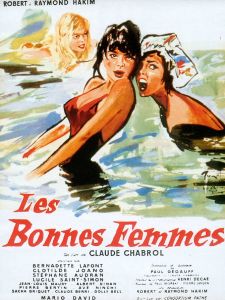
Having encountered early Chabrol once before, in ostensibly the first Nouvelle Vague film, Le Beau Serge, I thought I knew what to expect from Les Bonnes Femmes. I was wrong- in fact, I was surprised by the power and shock of it- an unsettling force that grows in unusual ways through gut-wrenching tonal shifts, and lingers in the viewer's memory. The bulk of the film treads the pleasurable, good times terrain of some early New Wave films (A Woman is a Woman, Brigitte et Brigitte), or in its anarchic jaded shopgirl feel, Chytilova's Daisies. Yet bookending this episodic play of love and work are two acts of patriarchal violence- an alluded rape, and an unambiguous murder at the hands of a stalker. The rape troubles the middle portion of the film, but without souring its comedic delight. With one of the women's murder, however, the entire narrative is thrown into confusion retrospectively, playing out with the impact of a fist in the stomach (not unlike the horrible attack that closes Breillat's Fat Girl.) A doe-eyed innocent murdered, and the fates of the other 3 protagonists abandoned, Chabrol segues to a dreamy coda that clarifies theme while furthering tonal confusion. An unknown woman sits alone in a dance hall, her face in shadows, under the narcotic trance of a mirrored ball and band. A man approaches, seen only from behind, and takes her onto the dance floor, fulfilling her only social role- to be brought into the world, made whole, through the predatory desires of the male. Is this a proto-feminist film?
The first 15 minutes of Les Bonnes Femmes are perhaps its best, tightly composed and edited, and bristling with a pervasive city lights energy not unlike the opening sequence of Touch of Evil. Men purposefully wait under the neon lights of an emptying theater; a group of women emerge, one bids goodbye to her boyfriend; the two men get into a car and follow them; simultaneously, a motorcyclist tails them all. Is this a Hitchcockian suspense? Intrigue set in motion? Surprisingly, neither, but rather a pair of crude philanderers cruising for girls, the mysterious cyclist falling away from the scene, to turn up later in a seemingly less menacing role. It is a confusing and suspicious sequence for the audience, that raises one's guard, but not enough to alienate us from the gaudy pleasures of the nightclub, zoo, theater, and swimming pool to come. Chabrol spends the next hour charming us with these 4 likable working girls who share employment at a perpetually dead electronics store, before our suspicions are vindicated. All 3 men in the opening sequence will come to be revealed as villains- rapists, murderers, bullies, sadists, and liars.
This is not to say that the time we spend with Jacqueline, Jane, Ginette, and Rita is padding or extraneous to the darker themes the film leaves us with. On the contrary, it is entertaining and thought provoking enough in turn that the shock of Jacqueline's murder would be meaningless if it did not jolt us out of something so engrossing. Prefacing, in a sense, their victimization, is Chabrol's sympathetic portrait of working class life for young women- the boring, long hours of standing around and looking pretty in shops, the sexual harassment from bosses and delivery boys, immersion in the world of luxury- but luxury only attainable by pawning their bodies to men. The looming presence of clock faces suggests a collusion of capitalism and patriarchy, beyond which, heroically, the young can still dance along in search of love and happiness. Indeed the "fun and games," acted with spirit (especially by Bernadette Lafont as Jane) is what distinguishes Les Bonnes Femmes from other capitalism-as-prostitution films of the same time like Godard's Vivre Sa Vie; without the juxtaposition of comedy/tragedy, joviality/violence its main point of interest is lost. Our heroines tramping through the zoo, for instance, is on par with the best antics of Jules and Jim, Karina and Leaud. And it should not be thought, based on the bleak ending, that Chabrol is a cynic in matters of love. Starry-eyed romance may lead to Jacqueline's downfall, but she is hardly to be faulted for her desires; nor Jane for her free-spirited flings, Ginette her chanteuse ambitions, and Rita her engagement with a neurotic square.
Returning to the question of Les Bonnes Femmes as a feminist, or proto-feminist film; it's a tricky question without clear criteria (and also grappling with by what degrees this is determined by content, production, etc.), but there is a critique in the film of the ugly forms of violence and exploitation to which women are subjected. Men are brutal predators, whose veneer of charm eventually gives way to naked aggression. Those men that defy this description are given a small sliver of screen time (Jane's beau), or are controlling in other ways (Rita's fiancee.) Beyond this, a feminist critique becomes more dubious, tempered as it is by the obvious male pleasures of watching beautiful young women carry on in tight dresses and bathing suits. Chabrol's construction ducks in and out of ideas like a game, dropping characters unceremoniously, coaxing emotional investment to have it turned into stone, and making us witness to the murder of a naif before dumping us into a starlit dance hall dream. Its a bold way of making a film, and raises my estimation of the guy (although from what I read his subsequent work loses a sense of experimentation and play.)